HOME  EXPERTISE
European Ceramics
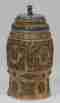
Our range reflects the entire diversity of eras, techniques and decorations. The earliest objects include Italian majolica as well as Siegburg, Raeren, Cologne, Frechen and Creußen stoneware from the 15th to 17th centuries.
An important majolica decorative bowl depicting St. Paul's sermon in Athens from 1550 came from Urbino (proceeds 32,000 euros).
The jugs from the Franconian town of Creußen served primarily as magnificent showpieces, such as the earliest known, dated Creußen Renaissance jug from 1611 (proceeds 17,500 euros) and a representative so-called “Apostle jug”, which was made in 1660 for the mayor of Rothenburg, Nikolaus Göttlingk (proceeds 9,000 euros).
Since the 17th century, Delft in the Netherlands has become a centre of faience art, where around 1680 the Het Jonge Moriaenshooft manufactory produced a pair of rare decorative vases with chinoiseries (proceeds 8,000 euros).
Faience was further developed in Germany from around 1680 in Frankfurt and the neighboring Hanau, and later also in many North German and South German factories such as Ansbach, Bayreuth, Crailsheim, Dorotheenthal, Erfurt and Magdeburg. Among the sought-after rarities are objects from the small Göggingen factory near Augsburg, which only existed from 1748 to 1752. A large narrow-necked jug with decoration in cobalt blue sharp-fire painting showed allegories of water, including shell motifs and a dolphin (proceeds 50,000 euros).
Already in the Art Nouveau and Art Deco periods, many artists, painters and sculptors discovered the great opportunities for development that ceramics offered them. In 1922, the sculptor Josef Wackerle modelled the almost life-sized majolica and faience figures of the "Four Continents" that were produced in the Nymphenburg factory and which he showed at the "German Trade Fair" in Munich (1922), at the famous III. International Exhibition of Decorative Arts in Monza (1927) and at the exhibition "European Decorative Arts 1927" in the Leipzig Museum of Decorative Arts (Grassi Museum) (proceeds 37,500 euros).
Pablo Picasso's collaboration with the Madoura ceramics workshop in Vallauris in southern France is legendary. They also produced limited editions based on Picasso's designs. These reflect his unbroken creativity, which continued into old age. In 1953 he created the artist's ceramic plate "Corrida sur fond noir" with a bullfighting motif (sales price: 12,000 euros), in 1964 the "Petit Buste de Femme" (sales price: 19,000 euros), and in 1969 the jug with a face "Visage aux points" (sales price: 13,500 euros).

Non-binding estimates
Do you own European ceramics or glass and would like to offer them at auction or have them valued without obligation?
Submit your valuation request here, which will be processed by our long-standing specialists within three working days.
You are also welcome to send us photos and documents of the objects available for sale to info@schloss-ahlden.de or by post.